

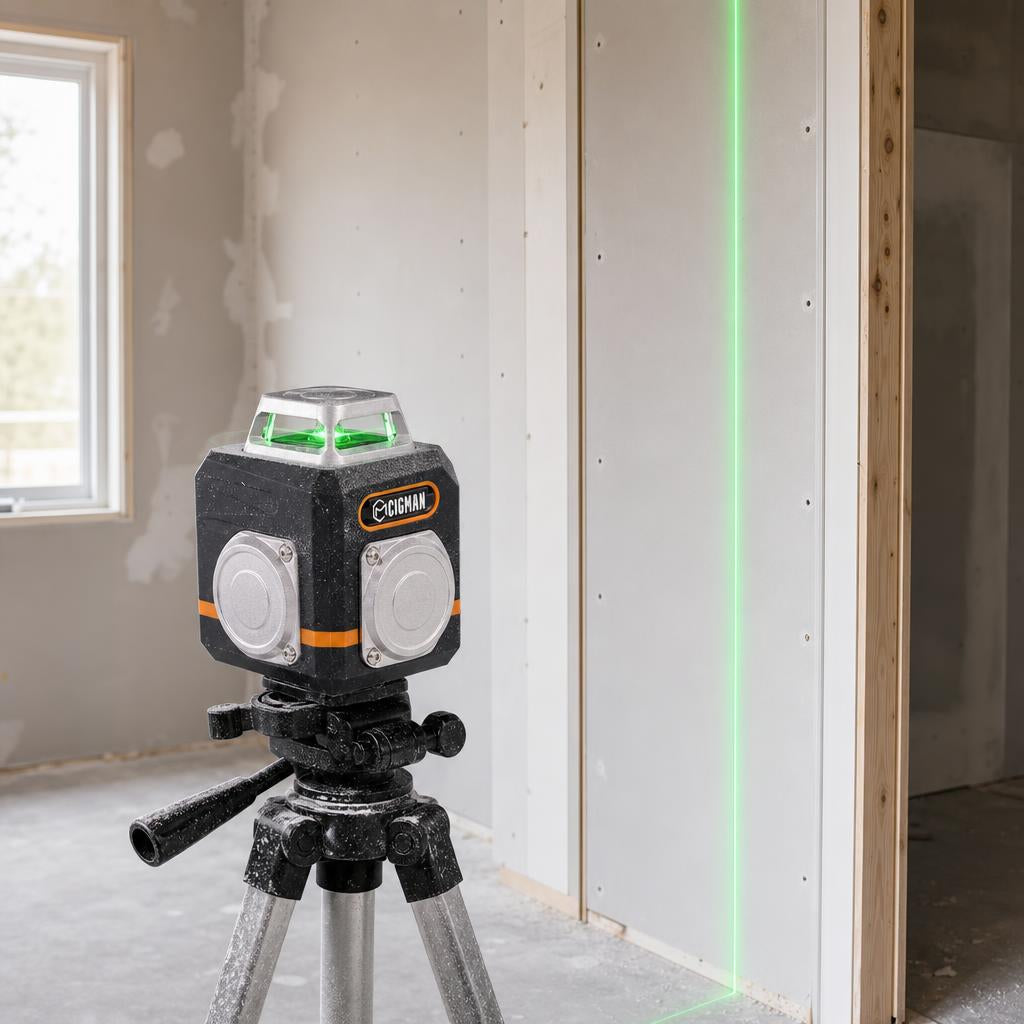
How to Check Plumb with a Laser Level

You measured the cabinet twice and it still looks crooked once it is on the wall. Nine times out of ten the wall behind it is not plumb, and a 4-foot level only checks the span it covers. By the end of this you will have a single vertical laser line running floor to ceiling, and you will know within a minute whether your wall, jamb, or cabinet is truly plumb.
What plumb means and when it actually matters
Plumb means perfectly vertical, lined up with gravity. It is not the same as level, which is horizontal. A wall can read level along the top plate and still lean out of plumb from floor to ceiling. Most people trust their eyes here, and that is the mistake. A wall that looks straight can bow in the middle or lean back a fraction of an inch per foot, and you will not see it until the tile lines fan out or the cabinet doors swing on their own.
This matters anywhere a finished surface meets a vertical reference: door and window jambs, kitchen cabinets, tile walls, and partition framing. Get it wrong and the door binds, the grout lines widen on one end, or the upper cabinets pull away from the wall at the top. A green beam is easier to see indoors than red, so if you are buying a tool for this kind of close work, read up on green versus red beam visibility first.
Set up the laser to project a true vertical line
- Stand the laser on a stable base near the wall. A tripod a couple of feet back from the surface works best. If you are mounting to a stud, make sure it cannot shift while you read it.
- Let it self-level before you trust the line. Most cross-line lasers suspend the diode on a pendulum and settle within about ten seconds. Do not mark anything until the beam stops moving and the line holds steady.
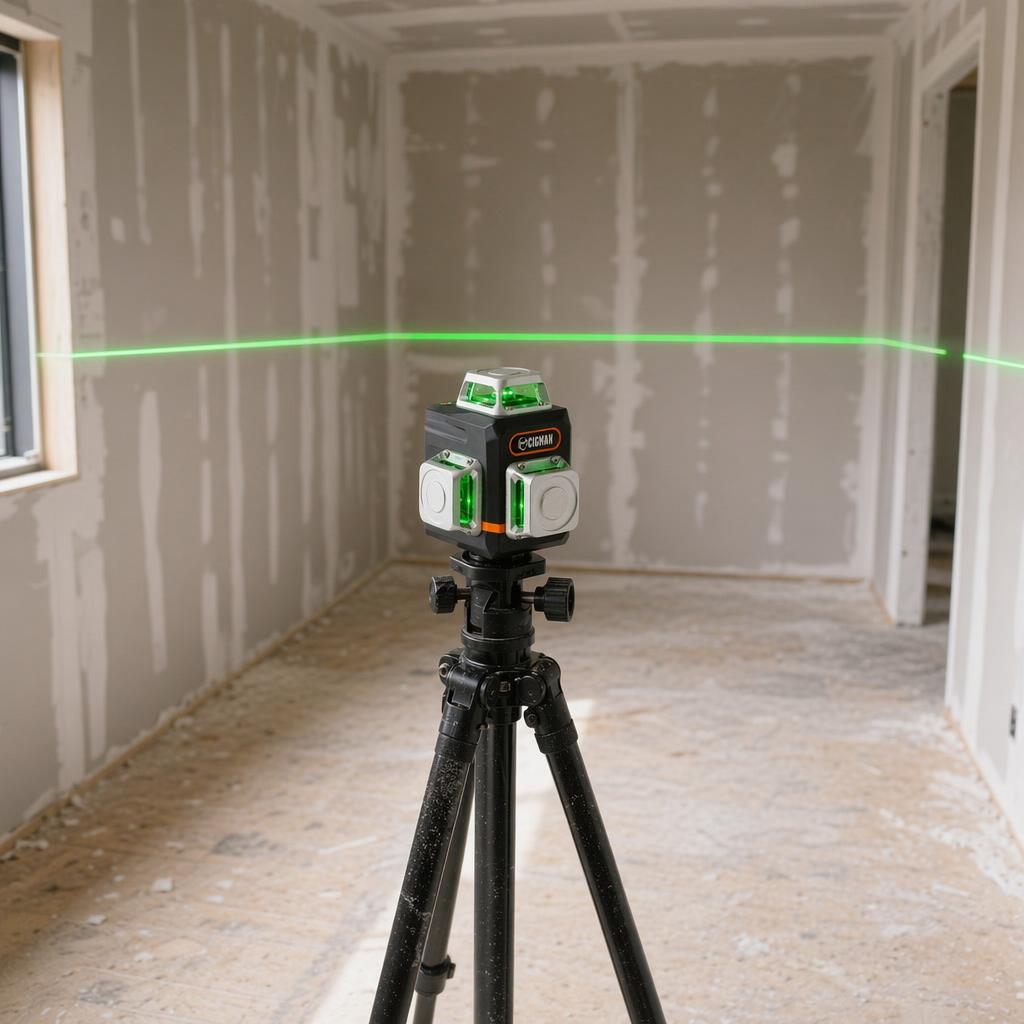
- Throw the vertical plane onto the surface. A 3x360° tool like the CM-701 casts a vertical plane that wraps the wall and continues across the room, so one setup gives you a plumb reference on every wall at once instead of one line at a time.

A laser level is a Class 2 device. Never sight down the beam or let it bounce off a polished surface into your eye. One forum user reflected a green beam off a brushed-aluminum level laid on a cabinet and was still seeing spots a week later.
If the vertical line blinks continuously on a flat surface, check the transport lock switch first. The CM-701 has a lock that pins the pendulum during shipping. With it engaged, the beam blinks on any surface regardless of how level the base is. Flip the lock to the unlock position and the line will stabilize within seconds. Real users have spent up to two hours assuming the surface was the problem before finding this switch.
Measure at three points to read plumb
The line itself does not tell you the wall is plumb. The line is plumb because the tool self-leveled. What you are checking is whether the wall follows that line. You do that by comparing the gap between the beam and the surface at several heights.

- Measure the gap at the top, middle, and bottom. Hold your ruler square to the wall and read the distance from the wall to the laser line at each height. Write the three numbers down.
- Equal gaps mean plumb. If all three readings match, the wall runs true to the vertical line. If they differ, the wall is out of plumb, and the point with the largest gap is where it leans away from you.
- Check more than one vertical run. Walls bow, so a single column can pass while the wall fails two feet over. Read at least two or three columns across the surface before you call it.
Knowing the gap difference also tells you how far out you are. The accepted workmanship guideline for stud plumbness is 1/4 inch in 8 feet when the wall will carry wallboard, plaster, or ceramic tile set in a mortar bed, tightening to 1/8 inch in 8 feet for tile set in dry-set mortar or adhesive [1].
Check a door jamb and a cabinet run
The same three-point method handles the two jobs where plumb matters most.

Door and window jambs
Set the laser a couple of inches off the hinge jamb and project the vertical line down its face. Measure from the jamb to the line at the top, middle, and bottom hinge locations. If the three numbers are not equal, slide shims in pairs between the jamb and the stud until they match. The advantage of the laser is that one person can adjust shims and watch the gap close without walking back to a bubble level every time.
Cabinet runs
For cabinets you work off the laser line rather than the floor or ceiling, because neither is reliable. A 360° vertical and horizontal reference lets you set the base cabinets to one line and trust that the uppers land plumb above them. It does not matter how level the floor is. The line you started from is what you build to. A 360° line that wraps all four walls is what makes a full run stay consistent corner to corner.
How plumb is plumb enough
There is no single legal number. Most guides claim the building code sets a framing tolerance, but the International Building Code and the American Wood Council's design standard contain no specific tolerance for light-frame wood construction. The plumb figures everyone quotes are industry guidelines, not code mandates [2]. That means the answer depends on the finish, not on a rulebook.
Bare framing is allowed to wander more than finished walls. Once wallboard, plaster, or tile goes on, the working target tightens to about 1/4 inch in 8 feet, and to 1/8 inch in 8 feet under thin-set tile [1].
A lean greater than 1 inch over 8 feet in a load-bearing wall is not a finish problem. Stop and have a structural engineer look at it before you build to it.
Not sure which tool fits this kind of indoor layout work? The laser level buying guide walks through line count and beam color by project.
Frequently asked questions
Can you actually check plumb with a laser level? Yes. A self-leveling laser projects a true vertical line, and you check plumb by measuring the gap between that line and the surface at the top, middle, and bottom. Equal gaps mean the surface is plumb.
My wall looks straight but the laser says it is off. Which is right? The laser. Your eye cannot catch a lean of a fraction of an inch per foot, especially when the ceiling or floor is also off and gives you a false reference. Trust the measured gaps.
Do I need a receiver to check plumb indoors? No. Indoors at normal room distances you read the beam directly off the wall. A receiver is for long outdoor runs where the beam is hard to see in daylight.
Red or green beam for plumb work? Green is easier to see on most indoor surfaces, which matters when you are reading a gap by eye. Red works but is harder to spot in a bright room.
Is a laser level safe to use around my eyes? A standard cross-line laser is Class 2, meaning visible light at 1 milliwatt or less, and the blink reflex protects you in under a quarter second [3]. Do not stare into the beam or let it reflect off a shiny surface into your eyes.
How far out of plumb is too far? For finished walls, more than 1/4 inch in 8 feet starts to show. More than 1 inch in 8 feet in a structural wall warrants a professional look.
The CIGMAN CM-701 ($149.99) projects three 360° planes, so one setup gives you a plumb vertical reference on every wall in the room plus a level line to work from. The remote lets you adjust settings from the measurement point instead of walking back to the tool.
References
[1] WoodWorks, Wood Products Council, "Construction Tolerances for Light Wood-Frame Projects," WoodWorks, 2023. [Online]. Available: https://www.woodworks.org/resources/construction-tolerances-for-light-wood-frame-projects/
Verified: June 2026.
[2] WoodWorks, Wood Products Council, "Construction Tolerances for Light Wood-Frame Projects (code context)," WoodWorks, 2023. [Online]. Available: https://www.woodworks.org/resources/construction-tolerances-for-light-wood-frame-projects/
Verified: June 2026.
[3] IEC 60825-1, Safety of Laser Products, Part 1: Equipment Classification and Requirements. Geneva: International Electrotechnical Commission, 2014. [Online]. Available: https://webstore.iec.ch/en/publication/3587
Verified: June 2026.



Laisser un commentaire
Ce site est protégé par hCaptcha, et la Politique de confidentialité et les Conditions de service de hCaptcha s’appliquent.